

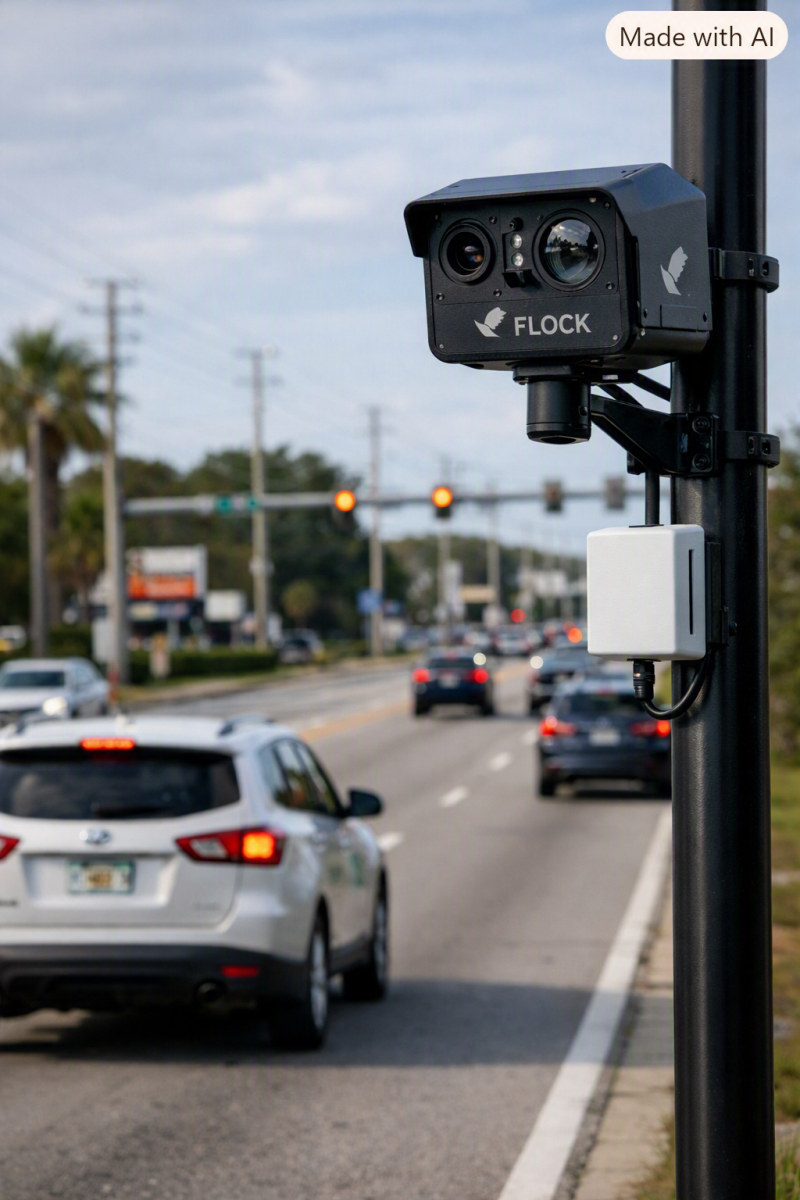
Daytona Beach residents are sounding the alarm over the rapid expansion of Flock cameras across the city, with many saying the system has quietly shifted from a public‑safety tool into a growing private‑sector surveillance network. As more cameras appear on major roads, neighborhood entrances, and commercial corridors, questions about data ownership, access, and long‑term implications are becoming impossible to ignore.
A Network That’s Growing Faster Than Public Awareness
Flock Safety, a private company based in Georgia, markets its cameras as crime‑fighting tools that help law enforcement identify vehicles involved in criminal activity. But in Daytona, residents report passing four, five, even six cameras on a single commute — often without any signage or public notice.
City officials have touted the cameras as a way to reduce theft, track suspects, and support investigations. Yet the system’s expansion has outpaced public conversation, leaving many unsure what information is being collected, who controls it, and how long it’s stored.
What Flock Cameras Actually Capture
Unlike traditional CCTV systems, Flock cameras don’t record video of people. Instead, they capture:
- License plate numbers
- Vehicle make, model, and color
- Distinctive features (roof racks, bumper stickers, damage)
- Time and location of every scan
Each scan is uploaded to Flock’s cloud servers, where it can be searched by law enforcement agencies that subscribe to the service. The company says data is stored for 30 days, but that policy is controlled by Flock — not the city.
This means a private company, not a government agency, is the primary custodian of the information.
Why Residents Are Calling It a Privacy Issue
The concern isn’t just the cameras themselves — it’s the structure behind them.
- Private ownership of public data: Flock, not Daytona Beach, controls the servers.
- Cross‑agency sharing: Police departments across the country can request access to Daytona’s scans.
- No public oversight board: Residents have no direct mechanism to review policies or challenge misuse.
- Potential for mission creep: A system built for crime prevention could expand into broader tracking without public approval.
Civil liberties advocates warn that even if the technology is used responsibly today, its long‑term implications depend entirely on the policies of a private company.
How the System Works Behind the Scenes
Flock cameras operate using automated license plate recognition (ALPR) technology. When a vehicle passes, the camera:
1. Snaps a high‑resolution image
2. Extracts the plate number using machine learning
3. Tags the vehicle with metadata (color, type, features)
4. Uploads the scan to Flock’s cloud
5. Makes the data searchable for authorized agencies
Police can search by plate number, partial plate, vehicle description, or even unique identifiers like a missing hubcap. The system can also send real‑time alerts when a flagged vehicle passes a camera.
This makes the network extremely powerful — and extremely sensitive.
The Debate: Safety Tool or Surveillance Grid?
Supporters argue the cameras help solve crimes, recover stolen vehicles, and locate missing persons. Critics counter that the system creates a passive tracking network capable of mapping a resident’s daily movements without a warrant.
The tension lies in the fact that both are true.
The technology is undeniably effective. It is also undeniably intrusive.
As Daytona continues expanding its camera network, residents are pushing for clearer rules, public transparency, and stronger oversight to ensure the system protects safety without compromising privacy.
Add comment
Comments